Showing posts with label thriller. Show all posts

Monday, August 17, 2026

Five by Five—Current events influence new book on the decline of democracy

By Max Bowen 

Duncan Ritchie’s technothriller “The Truth Chamber” (Sept. 1) takes the decline of American democracy to frightening ends. In an election year marred by violence, Democratic candidate Anna Hoffman warns a divided America that the country will devolve into a Russia 2.0 if her rival, Mack Leach (the Red Caesar), wins the White House.

After a confrontation with a book burner, Admiral Liam Driscoll joins Anna’s team, and he recruits a Stanford PhD student developing an AI technology called the Truth Chamber to figure out who is behind the escalating violence and an assassination attempt on Anna. Can the truth save America? Or will the Red Caesar bring an end to democracy as we know it? 

Learn more at www.duncanritchie.com.

What inspired this book?
The seed for “The Truth Chamber” was planted while I was working for a Japanese bank in Singapore in 2016, with the twin shocks of Brexit and Donald Trump's election. But the true catalyst came in 2022 after Russia invaded Ukraine. I watched UC San Diego professor Barbara F. Walter discussing her book “How Civil Wars Start: And How to Stop Them.” I devoured her book, then dozens of others. I began filling notebooks with "what if?" scenarios. Those notebooks became the foundation for “The Truth Chamber.”

Did current events play a role? If so, how?
Absolutely. I finished the first draft of “The Truth Chamber” the day after Joe Biden dropped out of the presidential race in 2024. It forced me to rethink the novel’s political backdrop. In the end, I knitted a speculative future to a (largely) historically accurate American past, diverging around 2016. My goal was to hold up a mirror to America, then tilt it forward slightly—a warning: “This is where you could be heading.”

Kirkus Reviews called “The Truth Chamber” “eerily prescient” and said, “readers may feel like they’ve found a history book from the future.” That’s a wonderful compliment. One of my editors put it slightly differently: writers don’t necessarily see into the future; sometimes they simply see what is happening a little earlier and more clearly than everyone else. I prefer that idea: that if we observe the present closely enough, the traces of our possible futures are already there.

What kind of research was done for this book?
Not being American has both helped and challenged me. I wanted to ensure my representations of America’s past and of an emerging fascist leader were broadly accurate. I came to the project without the potential benefits—or baggage—of an American education, and with a hell of a lot to learn. I read about 50 books on fascism, the history of race relations in the US, the Constitution, the Supreme Court, the role of money and religion in politics, and, of course, language and the art of deception.

I also spent six weeks traveling through nine US states during the 2024 election, visiting key locations in the book. I volunteered for the Harris campaign and knocked on doors in Atlanta, Georgia. That gave me direct experience of a campaign, albeit on the periphery. But more importantly, it gave me invaluable conversations with voters—a real-time temperature check on the American electorate in the days before the election.

How did your own career as a former banker help you when it came to creating the story?
I spent much of my career working on complex transactions across Asia, where political risk was often intertwined with financial risk—I lived through the Asian financial crisis and a coup in Thailand. You learn to ask hard questions: What could go wrong? What are we taking for granted? What happens if institutions, governments or political leaders behave differently from the way everyone assumes or expects they will?

I think that was why Barbara Walter’s interview and book caught my attention—she was identifying warning signs of potential instability and political violence in the US that we tend to associate with decaying democracies in more troubled parts of the world. So I did what risk analysts do: I followed those risks to their logical extremes. But this time, instead of putting my analysis in a briefing paper, I put it in a thriller.

What is your perspective on US elections?
I’m finishing up an essay on what I describe as America’s crisis of democratic legitimacy; in a sense, it’s the nonfiction companion to “The Truth Chamber.” I think ordinary Americans have every reason to feel frustrated and disillusioned with their elections, and with the widening gap between what citizens expect from their representatives and what their political institutions deliver.

As an outsider looking in, aspects of US elections seem bizarre—gerrymandering, dysfunctional institutions, the influence of money, the increasingly toxic polarization. It’s easy to understand why so many ordinary Americans feel the system isn't working for them. And there’s another emerging risk: the delegitimization of elections themselves. If people stop believing elections are free and fair, you risk losing democracy’s greatest strengths: its capacity for self-correction and the peaceful transfer of power.

It seems to me that a democracy designed in the 18th century is struggling to cope with the 21st. It’s a little like trying to run your iPhone 17 Pro Max on OS 1: without an upgrade, sooner or later, it’s going to crash.

Tuesday, March 24, 2026

Ink and Riffs

Ink and Riffs is a regular review series written by me, Citywide Co-Host Max Bowen, to talk about what I’m reading and listening to and why I think it’s awesome. Feel free to send suggestions to citywidemax@yahoo.com.

INK
“Beneath the Trees Where Nobody Sees: Right of Spring” (comic)
This sequel to the 2024 release of this truly addictive title continues the story of Samantha Strong, everyone's favorite brown bear who runs the town hardware store. Just one thing: Samantha’s s serial killer with dozens of bodies buried in the woods, and no one’s safe—even the residents of the town of Woodbrook, where she calls home.
When the sister of one of Samantha’s victims comes to Woodbrook seeking answers, Samantha is only too happy to help….wait, what? Well, this one’s going to be interesting, and I tore through the issues to get to the absolute mind-blowing ending.
Check out more about the series at https://tinyurl.com/4jsrna4y.


“Making it So: A Memoir” (book)
I’ve been loving Patrick Stewart’s autobiography. “Making it So” covers his entire life, beginning with his childhood in the small town of Mirfield, England. I’m at the part where Stewart discovers his love of acting and we begin to see the direction his life is taking.
The book is really amazing. He holds nothing back, giving the reader such detail that it effortlessly paints the picture. He speaks to the good and the bad, such as the difficult home life caused by his father, and how it impacted him years later. Being a fan of Stewart’s work since “Star Trek: The Next Generation,” I was very happy to get this book for my birthday and cannot wait to see what’s on the next page.
You can find this book at your favorite book retailer.


RIFFS
“War Child” (music)
Pop-rock artist Mick Rochford’s “War Child” brings us the story of loss of children in wars. This is a powerful and heartfelt story with a message we should all hear. “You didn’t know my name, but you kill me all the same” is such a strong line, one of many that you find in this single.
Follow Mick on Instagram at rochfordmick.


“Primadonna” (music)

“Primadonna,” by Donna Dafi really drew me in and kept me listening with its strong, eclectic pop sounds. Dafi draws on her German, Nigerian and Albanian roots, and I got a sense of power throughout the song. The music has the kind of energy and passion that can’t be ignored.
Learn more about Donna’s music by following her on Instagram at donnadafi.


Friday, January 9, 2026

Peeling the onion—Cash McCahill returns in new thriller

Author Paul Coggins
By Max Bowen

From nationally-recognized criminal defense attorney, Paul Coggins recently made the switch to writer with his debut thriller, “Sting Like a Butterfly,” and introducing the world to Cash McCahill, a criminal lawyer who finds himself on the wrong side of the law.

In his new book, “Chasing the Chameleon” (March 6, Savio Republic), A drug cartel gives Dallas defense lawyer Cash McCahill an ultimatum: betray his client or face death. He refuses to turn on his client, prompting the cartel to put out a hit on him. Instead of going on the run, he hides in plain sight by surgically altering his face and stealing the identity of a dead cop 20 years his senior.

Only two people know his secret: the surgeon who gave him a new face, and Tina Campos, a trusted paralegal in Cash’s law firm and a trans woman who helps others find safe, affirming care.


In this Five by Five, Paul talks about McCahill’s growth from the first book to the third, how his career influenced his writing and the messages for readers in the new book.

How has the protagonist changed from the first novel to now?
Between the first novel and the present, Cash McCahill (my protagonist) has done time for a crime he didn’t commit, lost and regained his law license, and gone underground to escape death at the hands of a drug cartel. His legal skills were always sharp, but his survival skills are sharper than ever.

How do you plan your books, given that it is a series?
The series is like the peeling of an onion. At the end of book one, a conspiracy is exposed to reveal a deeper and more dangerous conspiracy, which will be peeled back in book two. The end of each book should expose one conspiracy and tease the next one.

How does your experience with the justice system help you as a writer?
Cops and agents are the biggest gossips and yarn spinners on the planet. As a young prosecutor, I went out of my way to retain their tales, which were a mix of fact and fiction. Since it is nearly impossible to separate fact from fiction, I chose the course of least resistance and became a novelist.

How did you make the switch from prosecutor/defense attorney to writer?
Law and writing are complementary skills. A law professor once told me that 99% of success as a lawyer was picking the right word at the right time, which is 100% of being a good writer.

What are the lessons and messages in the new book?
Cash’s small law firm is the David that takes on a different Goliath in every book, and occasionally he squares off against more than one giant adversary. Diversity and inclusion are the keys to the success of Cash and the firm, which features his over-the-hill mentor, a Dreamer in constant fear of deportation, and a trans woman as the lone associate.


Tuesday, November 25, 2025

Five by Five—New mystery thriller incorporates a wealth of research

By Max Bowen

Michael G. Colburn’s Lady Black Mystery series has returned with the second book, “Asylum Murders” (Dec. 16). Set in the streets of 1890s Melbourne, Lady Edith “Edie” Black has reinvented herself. Once a notorious London thief, she now poses as a widowed aristocrat while secretly establishing herself as a private investigator.

In this Five by Five, Colburn dives into the lengthy research he did, particularly on the setting and time period and how he worked to get everything right. He talks about Lady Edith and how she came to be and what we can expect in future books.

How does the setting (both time and location) influence the story?
The details of the setting have to be as authentic as possible when writing a historical mystery in order to be believable. Building details and styling, street names, tram stops, the weather — all have to be researched to mesh with the story and action. Writing about the 19th century, I always use a period accurate map of the location I am writing about. Character names need to reflect the time and location as well. For example, I wanted to use the name Neil. I got conflicting information, so I had to dig further; I found Neil used as a first name in Tasmania, but I didn’t find it used in Australia. I was writing about the Torres Strait in eastern Australia; my Neil became a blackbirding pirate from Tasmania. In writing about a variety of locations, I rely on research as much as creativity.

What kind of research did you do when writing?
I did extensive research on daily activity and news in the locations where my books take place. Local newspaper archives are an important source. There is a wealth of information available in the daily news. During writing, a lot of the research is to make sure the words, actions, names and events fit with the 19th century and where the characters are located. I don’t try to convey accents or dialects; the reader can impose those if the wording works. As an example, in writing Lady Black Book Two, “Asylum Murders,” I found several events that became part of my story in the daily news of Melbourne. One example: there were reports of severed human limbs showing up in the Yarra River flowing through Melbourne. Some were dragged ashore by dogs. I never found where they identified a source of these limbs, and they became an important detail in my narrative.

How did you develop the character of Lady Edith?
I wanted a strong-willed lady lead. Many of the mysteries I read and enjoy have female lead characters. When researching the theft of the steamship Ferret for the beginning of “Stolen Brilliance,” the first Lady Black novel, I read an article in the Cardiff Wales newspaper that reported on ship activity in the port. It stated that James Henderson, the new “owner” of the Ferret, boarded the ship, refurbished and ready for departure, with a tall, elegant lady listed as his wife. I found no further reference to Henderson’s wife, and of all the many articles on the missing ship and subsequent activities of the thief, none mentioned his wife until a brief reference in Melbourne before and during his trial. There is no record that I could find that he had a wife, and that suited my needs perfectly. I built the lady into a story and a heroine.

What’s your process for creating a mystery?
I can’t always do this, but I try to find a time and place, involving genuine occurrences and actual crimes, preferably unsolved, to build into a narrative of investigation and sometimes resolution. I also want to build conflict and mystery between the characters along the way. In the first two books, I had multiple unsolved crimes that I could incorporate (and resolve in a fashion) using my characters and story. I try to write so that the multiple events that are real come together and are resolved by the end of the narrative, but leave room for surprises.

Was it always the plan to make this a series? How will things develop further in future books?
Yes, it was. While each book has a resolution, some details are left open to continue the story and relationship of the characters. For the forthcoming third book in the series, I’ll revisit another true event (the sinking of the R.M.S. Quetta) and build the book around it.

Tuesday, August 5, 2025

Five by Five—Take a ‘Chance’ with this legal thriller

Richard Danzig
By Max Bowen

Meet Chance Cormac, a litigator, boxer and lapsed Catholic who confronts hard facts about the law and himself. There’s a lot to learn about Chance and the cases he takes on over the three book series by Richard Danzig, with a fourth to be released next year.

In the newest book in the series, “The Collectors,” Chance is retained by a client who believes that he has been the victim of fraud when he purchased a valuable abstract painting that may be a forgery. Chance soon learns that both the painting and his client, might not be what they seem.

In this interview, Richard talks about the character and the cases he takes on, as well as some big news regarding the series. 

Pre-order the book here: https://tinyurl.com/5zs6upu9  

For those new to the Chance Cormac series, what is this all about?
There are three Chance Cormac legal thriller books; “Facts Are Stubborn Things,” “Punch Line” and “The Collectors.” Chance is a trial attorney who practices out of a brownstone, where he lives, in Brooklyn, New York.

Who is Chance Cormac and how did you create the character?
Chance is a former boxer, lapsed Catholic and zealous advocate for his clients. He represents the best lawyers I have met.

What inspired this newest part of the series?
“The Collectors” is based upon cases involving art fraud in the sale of fine art. It also involves the black market sale of human organs. Recently there have been articles about the removal of transplant organs before a patient has died.

I read that there is a potential TV adaptation. What can you tell us about this?
There is a pilot script for a TV show based upon the Chance Cormac books titled “Brooklyn Law.” It is presently being considered by various producers.

Will there be more books in this series?
Yes. The fourth book in the series, “Against All Odds,” will be published in 2026.

Sunday, July 6, 2025

Ink and Riffs: Daydreams and doomsday scenarios

Ink and Riffs is a regular review series written by me, Citywide Co-Host Max Bowen, to talk about what I’m reading and listening to and why I think it’s awesome. Feel free to send suggestions to citywidemax@yahoo.com. 

Jadelyn, “Daydream Diaries” (music)
I first heard Los Angeles-based Jadelyn’s music when she released “Throw it Back,” and was immediately hooked. When I came across her recent LP, “Daydream Diaries,” I immediately gave it a listen.

The five tracks cover a lot of ground, from “Throw it Back,” a tribute to the best times of yesterday and “Halfway Out the Door,” which touches on love lost that is made all the more painful for all the memories made.

The album title really encompasses the different tales—a musical journal remembering what came before, the things from the past we sometimes think about when something from the present reminds us.

The sound of the album is a slick pop style that shifts around from song to song. The core sound remains in the same lane, but weaves around with a mellow sound to one song and into a real foot-tapper in the next.

I really enjoyed Jadelyn’s vocals—a skillful, melodic voice that’s easy to enjoy. Looking at her discography, she’s been very active since releasing “Hard” in 2020, and her vocals have an essence of experience and passion for the music.

The Sacrificers (comic)
Imagine a world where the sun, moon, water, and more are all kept going by a pantheon of god-like beings. But these are not meant to be immortal dietitians. No, they’re meant to bond, have children, and die, leaving the next generation to take over.

Now imagine how these beings could throw off the shackles of mortality, and what—or who—it would take to make this happen, and what transpires when one supposed sacrifice says “No.”

That’s the world of “The Sacrificers,” an ongoing series from Image Comics, by New York Times-bestselling writer Rick Remender (LOW, DEADLY CLASS, Uncanny X-Force) and artist Max Fiumara (Amazing Spider-Man, FOUR EYES, Lucifer).

I was immediately drawn into this comic by Fiumara’s engaging artwork. The world he creates is powerfully emotional and diverse in its design. From the different forms of the pantheon that we’re introduced to, to the many races of the world, each page has something new and interesting to offer.

But let’s not forget the imaginative story that Remender has given us. The protagonist Pigeon is broken by the world, but still determined to keep moving to protect those most precious to him. The twists and turns are organic and keep the story moving at a strong pace.

Give this one a read—you won’t be disappointed.

Burn to Shine (audiobook)
The latest chapter in the Joe Ledger series by Jonathan Maberry continues in his unique nail-biter of a writing style. I’ve been a fan since the beginning and was eagerly awaiting the new release. Here’s a look at the story that awaits:

A covert group is infiltrating the world’s most secure bio-weapons research sites. All across the country, people are acting as human ‘disease bombs’ by infecting themselves and walking into public places. And heavily-armed groups of illegal private soldiers are massing for some unknown strike.

Joe Ledger and the members of Rogue Team International, still reeling from the devastation and heartbreaking losses of their last mission, are forced into relentless action to try and save the country, if not the entire world.

Old enemies are rising and joining forces to hit Joe and his team with one devastating blow after another. What is the end game for all of this madness and terror? Outnumbered, outmaneuvered, and outgunned, Joe Ledger has to find a way back from the fires of grief in order to make a stand between these enemies and millions of potential innocent lives. But Joe has allies, too. His team, the vicious fighters of Arklight, and friends who may or may not be entirely human.

I opted for the audiobook, though the physical book was also purchased, because Ray Porter is an absolute legend in the world of voice acting. He captures the complex emotions of the story, from the more lighthearted moments to when all seems lost and the darkness is closing in.

One things I’ve loved about Porter’s work is how he does the different voices, which range in tone, race, and gender. He does it all well and it’s clear he spends a lot of time crafting the real-life sound of each character. Check out the entire series, it’s an amazing listen.

Tuesday, February 25, 2025

Ink and Riffs: Dark dreams and chainsaw music

Ink and Riffs is a regular review series written by me, Citywide Co-Host Max Bowen, to talk about what I’m reading and listening to and why I think it’s awesome. Feel free to send suggestions to citywidemax@yahoo.com.

“Seeing Evil” (book)
This thriller by Jason Parent is centered on Michael Turcotte, a teenager who gains the ability to see the dark futures of others following a violent assault. The visions continue and eventually come to include Fall River Detective Samantha Reilly, who rescued Michael as a child following the deaths of his parents.

Eventually, Michael’s visions get him tangled up in the investigation of a suspected serial killer—one with a chilling connection to Michael and Sam.

This book was just amazing to read and at times I cursed having to go to work. Jason has a unique ability to not only craft a detailed scene, but take us into the minds of his characters.

Through the chapters, we really come to know Michael, Sam, and even the more minor characters and see what makes them tick. It serves to keep the reader hooked as they become more invested in their fates.

Another strong element of the book is the grisly, graphic details that Jason includes. Nothing is left out and this makes for powerfully impactful scenes that leave fans of the thriller and horror genres hungry for more.

“Angels” (music)
I’ve been a fan of the band RinRin since I heard their single “Shadows,” and this album is everything that makes this band my musical addiction.

The music is a great array of rock and metal, with some cool additional sounds layered on. “Angels” is a great opener, a solid musical punch to the face that’s followed up by “ChainsawGirl,” a really intense tune for a lot of reasons. The six-track EP has a lot more to offer, though, with all kinds of different sounds and stories.

“Angels” is a solid offering from a band that’s really hit their stride, and I’ll definitely be checking out the other releases that I’ve missed.

“Deep State” (comic)
Written by Justin Jordan with art by Ariela Kristantina and published by BOOM! Studios, “Deep State”follows John Harrow and his partner Agent Branch, as they investigate weird science, unexplained phenomena and all sorts of X-Files-esque oddities. Just the sort of comic I like to read.

I grew up watching “The X-Files” and “Men in Black,” so this story really got me. I finished the entire collection in a few days, and though it ends on a cliffhanger, I didn’t feel like a lot is left unexplained. I really liked all the different cases Harrow and Branch went on, from a Russian Cosmonaut infected with an alien tech virus to a gun that can fire bullets through time. Really cool stuff.

The overarching storyline of The Control, which runs the agency Harrow and Branch work for, was a cool element that smoothly develops alongside the shorter case files and really comes to a head in the later issues.

The art is really good, with sharp colors and a wide array of designs for the weird science and alien beings. You can tell Kristantina really dove into this and had some fun creating the world of “Deep State.” This comic has been a blast to read and I’m hoping we’ll see a return someday.

Monday, January 20, 2025

Kicking off the 2025 season with Jonathan Maberry

We’re getting 2025 off to a stellar start with one of the greats of the writing world! Author Jonathan Maberry is a NYT bestseller and 5-time Bram Stoker Award winner. He’s the creator of the Pine Deep Trilogy, V-Wars, Rot and Ruin and of course, the Joe Ledger series among many others.

In our first episode of the new year, Jonathan talks about “Burn to Shine,” the 14thbook in the Joe Ledger series. In this book, a covert group is infiltrating the world’s most secure bio-weapons research sites. All across the country, people are acting as human ‘disease bombs’ by infecting themselves and walking into public places. And heavily-armed groups of illegal private soldiers are massing for some unknown strike.

Old enemies are rising and joining forces to hit Joe and his team with one devastating blow after another. What is the end game for all of this madness and terror? Outnumbered, outmaneuvered, and outgunned, Joe Ledger has to find a way back from the fires of grief in order to make a stand between these enemies and millions of potential innocent lives. But Joe has allies, too. His team, the vicious fighters of Arklight, and friends who may or may not be entirely human.

Sounds pretty cool, doesn’t it? Jonathan, Curtis and Max talk all about the new book, the fights awaiting RTI and some callbacks to characters in past books.

Jonathan also talks about Joe Ledger, what defines this character, and how his trauma over the years has shaped him. We learn what keeps in the fight and why after all these years, he has no plans to back down.

We also talk about the big news that the Joe Ledger series has been optioned by Chad Stahelski, director of the John Wick movies to be optioned for TV development. Jonathan talks about how he and Chad met and the process of working together. We dive into potential actors to play Joe and where we are at in the production process. “Rot and Ruin,” his young adult zombie series, is in advanced development by Alcon Entertainment and we go into how that has come along.

After all these years, working in novels, comics, and much more, one would think that Jonathan Maberry has done it all, and we ask about his “Mount Everest” accomplishments and what else he wants to do in his career.


Monday, December 30, 2024

Five by Five: Noir novel brings a different perspective to southern towns


By Max Bowen


Writing coach and teacher Brandi Bradley brings her professional experience to bear in writing “Pretty Girls Get Away With Murder” set to be released on March 14. Here’s a look at the story synopsis:

When a young entrepreneur is killed, everyone in town points fingers at his fitness influencer ex-girlfriend, Gabbi – including the victim’s best friend, Jenna. As detective Lindy D’Arnaud and her partner Boggs search for a motive, they begin to wonder if this is a case of jealous violence or something much deeper. In Lindy's personal life, things aren’t much clearer. When Lindy’s wife’s ex-boyfriend–and sperm donor to their baby–decides to move back to town, she finds herself competing for her wife’s affection.

In this interview, Brandi talks about the Souther Noir genre, the use of different perspectives in her storytelling and her writing style.

How did your work as a writing coach and teacher help with this book?
Teaching actually helps me practice what I preach. For this book, I realized that I was not making the time to work on it, so I set up a few write-in sessions on my campus in the library and invited creative writing students to join me for an hour of uninterrupted writing time. I had to show up and work because there could be students waiting for me. It got me out of my rut.

What is the Southern Noir genre and why was it the one you choose to write in?
Typically noirs take place in cities – the dark and gritty city. Corruption, reputation, aesthetics, cynicism, money: small towns have to deal with this, too. Add to that the mythology of the Good Southern Family. Look at how everyone was intrigued by the Murdaugh case in South Carolina. People want to believe nothing bad happens in small southern towns, but that’s not true. And because these small towns are also hiding big juicy secrets, it makes a fertile ground for story ideas to grow.

Lindy sounds like she’s dealing with a lot in her personal life. How does this factor into the story?
I think Lindy would say she’s fallen under the spell of a pretty girl a time or two. It’s possible her experience makes her project and speculate on theories based on past experiences with women who were dangerously charming.

I like the shifting perspectives you use. How did this become your method of telling the story?
At first, I think I wanted to do a structure somewhat similar to what they did in “Big Little Lies,” where a person’s perception of events is clouded because of what they perceive as a slight or some imaginary adversary. And I remember a writing instructor telling me once to make sure I leave room for fun: to always keep something in my story that does nothing but bring me joy. And it was just too much fun to write in the voices of these women.

Did this story get planned out or was it more “seat of the pants” style?
Oh no. I’m a plotter. But I don’t follow any specific outline. I like to know where I’m going in a story. When I get started on a new idea, I open a Word doc and make a bullet point list of everything that needs to happen for the story to work. It’s more of a flexible list than anything else, but it suits me.

Sunday, December 15, 2024

Talking travel, robots, and Moscow marriages at the Rhode Island Author Expo

This December saw the return of the Rhode Island Author Expo, run by the Association of Rhode Island Authors. Along with emceeing the event, Citywide Blackout co-host Max Bowen sat down with some of the many talented writers to talk about their new releases, story inspirations, character development, and what we can expect down the road.

McLaughlin shares details of upcoming books
Heidi McLaughlin, New York Times, Wall Street Journal, and USA Today bestselling author, joins me to talk about her two upcoming novels, “Sail Away With Me” (Dec. 31) and “The Art of Starting Over” (Feb. 1). Both are romance stories, and we go into the details of the potential couples, her character development process and how these fit into her over 60 previous works.

Getting married in 1979 Moscow
Joann and Jim Mead have an interesting story about how they met—in Moscow 1979. In their new book, “Married in Moscow: A Red-hot Memoir during Cold War Times,” the couple talk about what brought them to Moscow in the first place and their memorable moments there. Joann and Jim share their first impressions of each other and how they went from two strangers to a marriage that lasted the years.

From travel blogging to crime thriller
To say that C.B. Giesinger has had a wide-ranging writing career would be putting it mildly. From her travel blogging, where she shows readers some of the best places to check out across the globe, she’s also tried her hand at all sorts of genres of books. Most recently, she released “Where the Salt Water Ends” a thriller in which the mother of a missing child begins an investigation when other kids are taken, and the truth is not something she wants to learn.

C.B. and I talk about her different types of writing, portraying strong female characters, and future works.

YA author is back with second “Courage Kids” book
In 2023, I got to meet debut author Nishita Roy-Pope to talk about her first book. “Courage Kids: The Secret Soccer Ball.” Now, Nishita has continued the series with “Courage Kids-Robots, Sharks and the Missing Glow” and with a name like this, you just know it’s going to be a great story. Nishita talks about what inspired this book and how it continues the first one. We also go into this new role for Nishita and how she plans to grow it in the future.

Kelly Swan Taylor shares the newest story in teen mystery series
Kelly Swan Taylor is now in the fourth volume of her Wright Detective series, this time set amidst a new love for her protagonist, Tessa Wright. We explore the different ways that the series has progressed and how Tessa has changed since the first book. Kelly also shares the role that Tessa’s love interest Mason plays in the new book as well as the potential for new titles.

Thursday, December 12, 2024

Five by Five—A special agent pens his life’s work into thriller series

By Max Bowen


Author Mel Harrison isn’t just a writer of thriller stories—he’s lived the life.

A former special agent and regional security officer with the State Department’s Diplomatic Security Service, Mel is the creator of the six-book Alex Boyd series, with the newest book, “Crescent City Carnage,” having been released in October. Here’s a look at the story:

Special agent Alex Boyd and his wife Rachel Smith are only a day into their New Orleans vacation when they discover their good friend and colleague, Simone Ardoin, has been brutally murdered. Simone’s parents, members of New Orleans’ high society, are devastated by the tragedy and implore both Alex and Rachel to work with local police to find her killer. The more Alex and Rachel delve into the case, the more deeply they’re drawn into a labyrinth of secrets as twisting as the city’s alleyways, and as dark as its hidden corners.

Mel talks about the New Orleans setting and its role in the book, as well as his background and how it shaped the story. He talks about writing a series and how his main character has evolved over the years.


Why was New Orleans chosen as the setting and how does it serve to drive the story?
While New Orleans is the first domestic setting in my six-book Alex Boyd thriller series, I selected the location because it has characteristics that are conceptually similar to my first five overseas adventures. The Louisiana culture in general, and New Orleans specifically, is unique in America. It is a rich gumbo of black and white, hard-working and laid-back, and innovative and corrupt. When you blend in the amazing food, incredible architecture of the city, and history, it forms the perfect backdrop for a heart-pounding and emotionally captivating story setting.

How was the character of Alex Boyd created and how has he changed over the course of the series?
I developed Alex Boyd’s character based upon my own background as a special agent and regional security officer with the U.S. State Department’s Diplomatic Security Service. Of course, I enhanced certain things to make Alex exciting and memorable to the readers. I created his physical appearance to set an image in the mind of the audience. He’s tall, good-looking, a tough guy, and big enough to handle most situations.

I felt it vital that he also have a keen sense of humor. After-all, in the Foreign Service you meet a range of people in both the embassy and among the foreign community who have divergent views and customs. And you are dropped into dangerous situations that would stress most people. Humor helps deal with this. Also, Alex is successful because he is dedicated to the job and to keeping people safe.

Rachel Smith’s parallel career in the Foreign Service as a press officer and later a senior political officer was created by me to bring readers into the real world of smart couples trying to make it in the challenging world of diplomacy. The humorous banter between Alex and Rachel continues in all the books. As for how he has changed in the series, once he meet and falls in love with Rachel Smith he realizes there is much more to life than merely “the job.” Being a team in every aspect of their life is vital to him.

Was it always your intention to write a series?
Yes, I always wanted to write a series, I just wasn’t sure how many books would be included. I was certain I would have the same protagonist throughout the series. In addition to having Alex Boyd as my lead character, I knew I wanted to have a strong female lead, Rachel Smith, who was an intellectual match for Alex, and also a physical match as well. As I intended to put both of them in harm’s way, I gave each of them the fighting skills to deal with adversaries. I also decided it would be useful to bring back a few secondary characters into subsequent stories, thereby creating linkages that would exist in real life.

How has your professional experience helped you as a writer?
The first bit of advice I learned when I decided to be an author was to write what you know. I have drawn on my knowledge of living overseas, working in American embassies, and dealing with real crisis’ to craft my stories. All of my books are set in locations where I have either lived for several years or worked there from time to time. My characters are fictional, yet they are a composite of people I worked with in different settings. The stories are occasionally based upon events that actually happened, but I have taken the liberty to jazz them up or modify them to excite the reader. As for the extraordinary relationship between Alex and Rachel, well, you will have to draw your own conclusion.

What got you into writing in the first place and why is the thriller genre the one you chose to work in?
Toward the end of my career, I believed I had enough interesting and exciting experiences to write thrillers that would appeal to a broad range of readers. Picking the thriller genre was a no-brainer for me. Thrillers and action-adventure novels are the types of books that I personally enjoy reading. My knowledge of dealing with terrorism, riots, kidnapping and verbal foreign policy disagreements was sufficient to form the basis of each story. When I retired to Florida and moved into my current community, I found it had numerous writing groups to help individuals create the type of books that they yearned to create. I am very grateful to all those who helped my writing improve.

Friday, September 20, 2024

The debut of Ink and Riffs!

Ink and Riffs is a regular review series written by me, Citywide Co-Host Max Bowen, to talk about what I’m reading and listening to and why I think it’s awesome. Feel free to send suggestions to citywidemax@yahoo.com. 


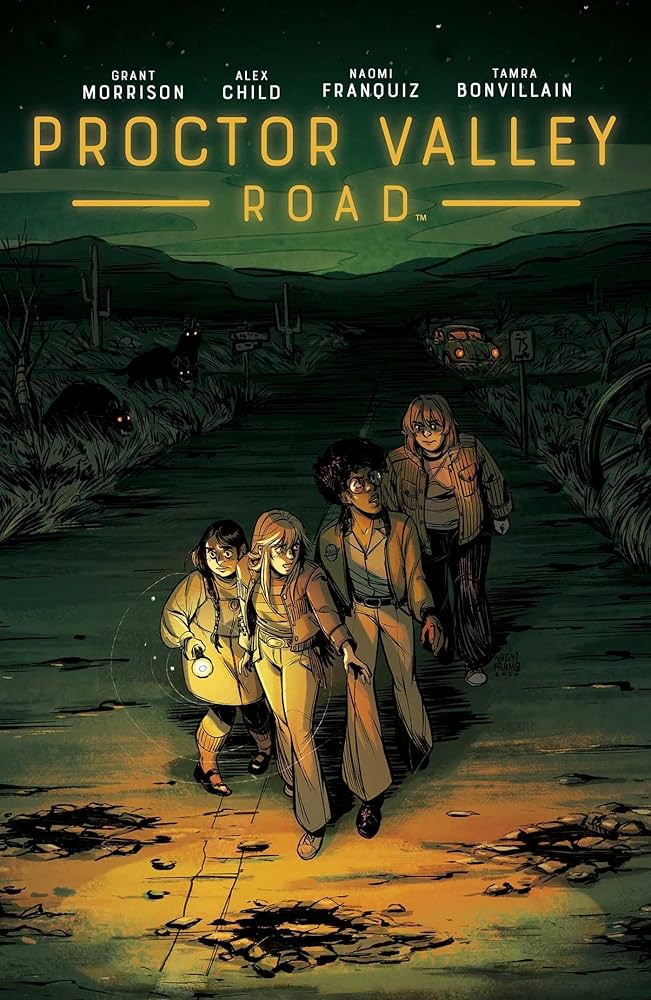
Proctor Valley Road (comic) — What to do when you just gotta have those Janis Joplin tickets? Well, charging for a trip down a supposedly haunted road seems like a good idea….just so long as it’s not actually haunted.


Writers Grant Morrison (Klaus), Alex Child (BBC’s Holby City) and artist Naomi Franquiz (Tales from Harrow County) have created this singular horror series released by BOOM! Studios. August, Rylee, Cora & Jennie organize a “Spook Tour” on the most haunted stretch of road in America, but when things go south, they not only have to face the monsters, but the town that holds them responsible.


What drew me in wasn’t just the creepy horror atmosphere, but the characters themselves. They all have a deep backstory, such as Cora’s crippling fear of the dark or Jennie’s dream of being an astronaut and taking down the social barriers in her way. You get to know these four well and care about them a lot more when things go south. The art is also really good and Franquiz does a great job at creating a horrifying world that is always getting scarier. 


Check out the comic at https://www.boom-studios.com/series/proctor-valley-road/


White Fire (book) — I’ve long been a fan of the Pendergast book series by Douglas Preston and Lincoln Child, and recently picked up where I left off awhile ago. Here’s a quick look at the plot:


“In 1876, in a mining camp called Roaring Fork in the Colorado Rockies, eleven miners were killed by a rogue grizzly bear. Corrie Swanson has arranged to examine the miners' remains. When she makes a shocking discovery, town leaders try to stop her from exposing their community's dark and bloody past.”


As I write this, I’m just about done with the book and it’s been a real pleasure to read. I loved the setting and how it plays into the story. The twists, while not hard to guess this time, were fun to encounter and the different characters are deep and well thought-out. History is often a big part of these books and the look into the town’s past, both good and bad, was one of the more enjoyable aspects.   


If you’re looking to give this a read, visit https://www.prestonchild.com/books/whitefire/


Pale Strangers (music) — The self-titled EP by this kickass rock duo is showing a strong start to this new project, formed following a separation of their last band, Rival Bones. 


This is the kind of rock I grew up with, and listening to “Pale Strangers,” I’m reminded of a lot of the bands I love, while at the same time, appreciating the fact that these guys are bringing their own elements to the music. 


The quick and fierce intro leads to “Deep Waters,” amps up fast from the opening chords. “Witches of the Wasteland” is my personal favorite from the album a real wave of sound with a chorus that I can easily see myself singing along to.


The five-track EP brings a lot to the table, with strong, precise instrumentation blended with some powerhouse vocals. This is the kind of music that has you moving right off the bat, and that alone tells me that this is a band worth listening to. 


Hear all the band’s music at https://open.spotify.com/artist/2jvUQiQnxK3uLpj67dwP8N?si=hciGv-HyQ76m1nJpZ8LRRQ


Thursday, September 19, 2024

Citywide Bytes—Justin Lee breaks new ground in fourth book

After hearing this interview, I hope you’ll all be a little more careful when you open that random email. Because you never know.

Author Justin Lee is back with a new book, “The Reluctant Reckoner” (Oct. 8) and in this episode, we talk all about protagonist Mark Righters, an ordinary man caught in a world he is wholly unprepared for. Here’s a look at what’s in store:

An honest accountant who likes to keep it simple, he's been at the same company for 23 years and prefers things the way they are: steady, with little excitement, and even less change. His health, 8-year-old daughter, and small suburban home are all he needs. But after that e-mail, everything is at risk.

Somehow framed for a financial discrepancy that could send him to jail, at first, he's just bewildered. But when the crime mysteriously disappears just as quickly as it emerged, it's clear just how outmatched Mark really is.

Then he's kidnapped, blindfolded, and given a timeline to steal confidential information. He doesn't know who the perpetrators are, what they need it for, or why they asked him. But he does know they know things about him. Personal things. Things they can't possibly know


Justin and I talk about the kind of person Mark is and how he navigates this plot. He goes into his growth as a writer and the new territory he got to explore in this, his fourth book. We also look at how, after four books and several awards, Justin feels that he has “arrived” as a writer.


Tuesday, September 10, 2024

Joseph Falank combines personal drama with a spooky atmosphere in his newest book

Three couples. A weekend at a secluded lake house. What could go wrong?

Quite a lot, as it turns out. Joseph Falank’s new book, “The Vanishing at Echo Lake” (Oct. 22), combines the each couple’s relationships issues with a mysterious cabin where the living have a tendency to go missing without a trace.

Joseph talks about what inspired the book, not his first in the horror genre, and how he created both the world of the cabin and the people, in a way that makes them matter to the reader. He goes into the force surrounding the cabin and how we learn of its effect on the people there. The book’s set amidst the COVID pandemic and we look at why this was done and how it impacts the story.

Joseph even gives us a sneak peek at his next project, a fantasy story that his daughter helped inspire.
 

Sunday, August 25, 2024

John Raposa tries a new genre with “All In The Cards”

When author John Raposa was last on the show, it was in 2017 for his dystopian thriller “Children of Apis” series. Now, he has a new book out, “All In The Cards” and while the book is indeed a thriller, this has a much darker tone. Here’s a look at the synopsis:

Danny and Leigh are your typical teenagers until a mystical deck of cards comes into their possession. What started as an innocent visit to a gypsy's tent results in a decision that alters the path of their lives.

For Danny, the cards are both intriguing and addictive. To Leigh, they have a dark quality that should have been left alone. As the lives of Danny and Leigh unfold, the cards' sinister nature begins to emerge, and their dark powers have a chilling reach.

As the cards' predictions are revealed, Danny and Leigh are forced to question everything they thought they knew. Are the cards really predicting their future, or is it all mere coincidence? And what is the true purpose of this sinister deck?

In this episode, John, Curtis and Max talk about where the idea for the book came from, and his use of a regular deck of playing cards for this dark presence. John goes into the new experiences he had in the writing process for a psychological thriller and how he developed his main characters.

Monday, August 5, 2024

Five by Five: In her debut novel, Jude Berman shares a story of saving democracy

By Max Bowen

Author Jude Berman’s debut novel, “The Die,” saw its roots following the results of the 2016 presidential election, and in 2024, she sees the message as even more important. Here’s a look at the plot:

Darah, a tech writer living in the democratic nation of California, is dismayed to see the game she’s helping develop for a Silicon Valley tech company has been tampered with. When her hacker friend Jedd investigates, he uncovers a conspiracy that could change the nation—and the world.

With a circle of close friends, Jedd digs deeper and deeper into the darknet and exposes the unthinkable: an app is being developed that uses quantum computing and neuroscience to alter people’s brains, totally unbeknownst to them. As the friends realize the devastating impact of this technology, they’re presented with a dilemma: stay quiet and stay safe, or risk their lives to stand up to the international authoritarian force behind this plot?


In this new Five by Five interview, Jude shares the origin of the book, how it developed, as well as how it ties elements of spirituality with the current times. She talks about the lengthy research done for the science of the book, how she developed her main characters, Darah and Jedd, and the roles of cultural diversity and social justice in the story.


What about this topic appealed to you enough to write a book about it?
In a nutshell, the topic of “The Die” is saving democracy. I began writing it immediately following the 2016 election, after talking to so many people who expressed shock and dismay yet who had done little or nothing that might have contributed to a different outcome. I saw a soup of apathy, fear, anger and delusion. Some folks didn’t seem to think it made much difference whether they lived in a democracy or a dictatorship. Others saw the difference, but said politics was too dirty; even watching or reading the news was too toxic for them. Most of these people, if asked, would self-identify as “spiritual.”

I was deeply troubled by this tendency to create a dichotomy between our spiritual and worldly lives. How can our country—not to mention our planet—survive if we hold back from fully and lovingly engaging with it? In fact, I’d spent decades studying ancient sources of wisdom that defined spirituality in terms of our ability to appreciate the oneness of the universe and to carry that vision into each moment of daily life. Knowing most readers aren’t likely to pick up what they think is an archaic text, I wanted to incorporate the essence of that wisdom into a futuristic story that is both relevant and entertaining. In 2024, with the future of democracy even more on the line, I’m thankful I followed through on this topic. I only hope it’s not too late.

Do you have a lot of experience with this kind of science, or did this require some research? If so, what did you learn?
The nice thing about writing speculative fiction is that it allowed me to have a bit of fun with the science. I had the freedom to create any technology I wished, as long as I was fairly confident no one could definitively prove it couldn’t exist within the time frame I was suggesting it might. A low bar, really (which I made lower by not giving any specific dates for events in “The Die”). When I was on the academic staff at Stanford during the early boom years of Silicon Valley, just about everyone I knew was associated with one or another startup company, and when I began freelancing as a writer and editor, I did consulting gigs at various tech and biotech companies. So I’d say that—while I’m neither a hacker nor a gamer—I did get the basic lay of the land.

Fortunately, I have a strong research background and enjoy putting it to use. For example, the products in R&D at the company where our heroes work include smart dust and neurodust, which I learned about through my research. I also researched the timeline for the market introduction of aero cars, which I discovered is a bit of a moving target (pun intended). I didn’t have to do much research on the neuroscience I included, because I was familiar with that content from my work as an editor over the years.

How did you develop the characters of Darah and Jedd?
All the characters in “The Die” are based on counterparts in the ancient epic of the Mahabharata. Darah is based on Draupadi, and Jedd on Yudhishthira. I wanted Darah to be the only one who had experienced life in a dictatorship; that would enable her to appreciate some threats the others could not see and potentially to warn them. It also meant she would have sensitivities and vulnerabilities the others did not have—something that is both her strength and her weakness. I drew on my own experience when developing her character. Like Darah, I’m a first-generation American. While her mother was deported from the dictatorship to Afghanistan, my mother was arrested and then expelled from Nazi Germany. Like my mother, Darah suffers from PTSD; like me, she has intergenerational trauma. Notably, she works as a tech writer, something I used to do.

My original model when developing Jedd was Barack Obama. In addition to looking kind of like a younger Barack, Jedd has a similar wily combination of intelligence, problem-solving ability, leadership, and unshakable cool. Like Yudhisthira, Jedd has one human flaw: blindness when it comes to gambling. That flaw plays a pivotal role in both “The Die” and the ancient epic, suggesting that, despite the vastly different eras in which these stories take place, some basic aspects of human nature have not evolved all that much.

I read in your bio that your parents instilled “a deep appreciation for cultural diversity and social justice.” Does this come through in the book?
I think it comes through in various ways. I knew going into the project that, while the heroes of the Mahabharata are the five Pandava princes, having five male leads in “The Die” was a nonstarter. So I set about creating a diverse cast. Darah, in addition to being a woman, is a first-generation Afghan American. Jedd is a biracial man; his mother is Jewish and his father is African American. June is an Asian American woman. Beers is a physically large White man. Nick and Zack, based on twin brothers in the epic, are two gay men who look very much alike and jokingly call themselves twins. While it might seem obvious that all current fiction should reflect the diversity of our culture, I’m continually surprised at the extent to which this is not the case.

Social justice is central to the plot of “The Die,” as the characters fight to save democracy from a dictator who would destroy any prospects for a fair and equal society in which each person’s rights are respected and protected. I drew on the concept of dharma, from the Mahabharata and other Eastern traditions, to exemplify the principles of equitable and right action and of working for the greater good of all. How ironic that we could learn how to embody principles central to social justice from wisdom dating back to an era when monarchy and social hierarchy predominated.

I also read that you’ve worked as an editor and running two small presses. Did this help you in the writing or publishing process?
Being both a developmental and a copy editor certainly helped. I’d almost go so far as to say this book (and the two that are forthcoming—“The Vow” [Oct. 24] and “Shot” [July 25]) would be no more than a twinkle in my brain if I didn’t have those skills. Running the small presses didn’t affect my writing but it did inform my journey through the publishing world. I learned firsthand the critical importance of both distribution and marketing/promotion for a book’s success. When many people were turning to self-publishing, I swore I’d never do that because I wasn’t going to underestimate the challenge of getting a book into the hands of readers. At the same time, while I had always venerated traditional publishing, I began to see that wasn’t a viable route for me, due to my age and lack of a large enough social media following. When I learned about hybrid publishing (specifically, SparkPress/She Writes Press), my experience with small presses led me to quickly appreciate how the hybrid model could offer the best of both worlds. Some authors new to hybrid publishing struggle with their responsibility for promotion, but my experience with small presses made it easier for me to see why and how I needed to jump in. Plus, I had a partner in my publisher, so I didn’t feel the burden of self-publishing—or for that matter, the stress of running a small press.

Thursday, July 4, 2024

“Hard Style Juice” tells a murder mystery through a wrestling lens

I’ve been a fan of both professional wrestling and comics for many years, so getting to talk about both for this interview was just perfect.

Writer Clay McCormack, artist Ricardo Lopez Ortiz and I dive into “Hard Style Juice,” a new series that you can only see on Comixology Originals. Here’s a look at the story for those new to it:

Wrestling is big business in arenas across the country, and for the Castros, it’s the family business. "King" Castro is the patriarch of the family, he’s also the manager, booker, promotor, MC, and owner of the local independent wrestling promotion KCPW, King Castro Pro Wrestling.

His daughter, Ramonita "Mona" Castro, has dreams of going to business school, but also has a penchant for wrestling. And his son, Rey Castro, is the star. A real showman, Rey is known as the "King of the Death Match," and he's on the verge of getting a contract to go pro.

Pro wrestling built the Castro family, and now it’s about to tear it apart. A shocking in-ring death sends the family spiraling out of control, and down the path of revenge as one big question rears its head: was it an accident? Or was it murder?


We talk about the series origins, and how Clay and Ricardo’s interest in wrestling played a role in shaping it. Clay talks about working with murder mysteries and how he paces the story, while Ricardo shares how he captured the feel of the wrestling world and his favorite parts to draw.

The series is now three issues in, with the fourth to be dropped on July 16, and we go into where the story is now and a few hints as to what we can expect in future issues.


Saturday, April 27, 2024

Dennis Hopeless shares his past in new comic series

Dennis Hopeless is known for titles such as X-Force, Darth Vader, Suicide Squad and Invader Zim. Now, he shares a true-life story in the Comixology-exclusive title “She’s Running on Fumes.”

Set in Deepwater, Missouri circa 1984, a criminal named Jody is severely injured in a car wreck and his wife discovers he was a drug trafficker and begins her own criminal career in a desperate bid to keep her family afloat. The twist is that this tale of crime and survival is inspired by Hopeless' own parents.

In this episode, Dennis talks about what led him to bring his family’s story to this new series and how his mother helped him to collect all the details. We talk about his past work, which includes titles like X-Force, Spider-Woman and Suicide Squad and how at times his own backstory inspires what he’s written.

Dennis goes into the fiction portion of “She’s Running on Fumes” and how he views this portion of his life, which he witnessed at a very young age. He talks about how he views his father as a person, all these years later.


Saturday, April 13, 2024

Mystery boxes and twist endings with “Jill and the Killers”

Who doesn’t love a good mystery? Oh, what’s that? It’s a real crime? And we need to solve it? And we could be killed? Yeah, that’ll be fine.

In the Oni Press four-part series, “Jill and the Killers,” teenager Jill Estrada is dealing with the unsolved disappearance of her mother, a police detective, and trying to get back to a normal life. . . . even as her friends become obsessed with Box Killers, a true-crime subscription game where each month’s “unsolved case” is custom-tailored to the life of its player. There’s only one catch: Jill’s game seems to be all too real—and when her clues begin to connect the dots to a very real series of disappearances in her hometown, Jill and her friends must conquer their fears and own personal struggles to solve the case.

Series writer Olivia Cuartero-Briggs joins us to talk about its origins, as well as why she chose to use a subscription box as the vehicle for the story. Olivia worked with artist Roberta Ingranata on “Jill and the Killers” and we talk about how the two met and the collaboration process. Olivia’s worked on murder mysteries before and goes into how the past experience informed this new project.

We’ve gotten the chance to read the final issue (out on April 17), and while we won’t be giving out any spoilers, Olivia does share how she devised the end of the series and hints at a possible continuation.