Tuesday, November 25, 2025
Five by Five—New mystery thriller incorporates a wealth of research
Michael G. Colburn’s Lady Black Mystery series has returned with the second book, “Asylum Murders” (Dec. 16). Set in the streets of 1890s Melbourne, Lady Edith “Edie” Black has reinvented herself. Once a notorious London thief, she now poses as a widowed aristocrat while secretly establishing herself as a private investigator.
In this Five by Five, Colburn dives into the lengthy research he did, particularly on the setting and time period and how he worked to get everything right. He talks about Lady Edith and how she came to be and what we can expect in future books.
How does the setting (both time and location) influence the story?
The details of the setting have to be as authentic as possible when writing a historical mystery in order to be believable. Building details and styling, street names, tram stops, the weather — all have to be researched to mesh with the story and action. Writing about the 19th century, I always use a period accurate map of the location I am writing about. Character names need to reflect the time and location as well. For example, I wanted to use the name Neil. I got conflicting information, so I had to dig further; I found Neil used as a first name in Tasmania, but I didn’t find it used in Australia. I was writing about the Torres Strait in eastern Australia; my Neil became a blackbirding pirate from Tasmania. In writing about a variety of locations, I rely on research as much as creativity.
What kind of research did you do when writing?
I did extensive research on daily activity and news in the locations where my books take place. Local newspaper archives are an important source. There is a wealth of information available in the daily news. During writing, a lot of the research is to make sure the words, actions, names and events fit with the 19th century and where the characters are located. I don’t try to convey accents or dialects; the reader can impose those if the wording works. As an example, in writing Lady Black Book Two, “Asylum Murders,” I found several events that became part of my story in the daily news of Melbourne. One example: there were reports of severed human limbs showing up in the Yarra River flowing through Melbourne. Some were dragged ashore by dogs. I never found where they identified a source of these limbs, and they became an important detail in my narrative.
How did you develop the character of Lady Edith?
I wanted a strong-willed lady lead. Many of the mysteries I read and enjoy have female lead characters. When researching the theft of the steamship Ferret for the beginning of “Stolen Brilliance,” the first Lady Black novel, I read an article in the Cardiff Wales newspaper that reported on ship activity in the port. It stated that James Henderson, the new “owner” of the Ferret, boarded the ship, refurbished and ready for departure, with a tall, elegant lady listed as his wife. I found no further reference to Henderson’s wife, and of all the many articles on the missing ship and subsequent activities of the thief, none mentioned his wife until a brief reference in Melbourne before and during his trial. There is no record that I could find that he had a wife, and that suited my needs perfectly. I built the lady into a story and a heroine.
What’s your process for creating a mystery?
I can’t always do this, but I try to find a time and place, involving genuine occurrences and actual crimes, preferably unsolved, to build into a narrative of investigation and sometimes resolution. I also want to build conflict and mystery between the characters along the way. In the first two books, I had multiple unsolved crimes that I could incorporate (and resolve in a fashion) using my characters and story. I try to write so that the multiple events that are real come together and are resolved by the end of the narrative, but leave room for surprises.
Was it always the plan to make this a series? How will things develop further in future books?
Yes, it was. While each book has a resolution, some details are left open to continue the story and relationship of the characters. For the forthcoming third book in the series, I’ll revisit another true event (the sinking of the R.M.S. Quetta) and build the book around it.
Sunday, August 31, 2025
Ink and Riffs: Murders, music and magic
Beneath the Trees Where Nobody Sees (comic)
Without a doubt, this has been one of the best comics I’ve read in some time. Here’s the story:
Don’t. Murder. The locals.
This is small-town serial killer, upstanding citizen, and adorable brown bear Samantha Strong’s cardinal rule. After all, there’s a sea of perfectly ripe potential victims in the big city just beyond the forest, and when you’ve worked as hard as Sam to build a cozy life and a thriving business in a community surrounded by friendly fellow animal folk, warm decor, and the aroma of cedar trees and freshly baked apple pie…the last thing you want is to disturb the peace.
So you can imagine her indignation when one of Woodbrook’s own meets a grisly, mysterious demise—and you wouldn’t blame her for doing anything it takes to hunt down her rival before the town self-destructs and Sheriff Patterson starts (literally) barking up the wrong tree.
This was the original graphic novel debut by writer-artist Patrick Horvath, and I gotta say, he’s off to a hell of a start. The story was dark, tense and kept me guessing until the twist (and twisted) ending. The art reminds me of the books I read as a kid, which really just serves to make the whole thing even more surreally creepy. Read this one and then check out the new sequel series.
Work in Progress (music)
I’ve been a huge fan of the music of gavn! for some time, and this new album, “Work in Progress,” is a great example of his skill with music and vocals. The flow of the seven-track EP is powerful and passionate, from the opening track, “Eventually,” and continues throughout.
“Dead to Me” really stood out to me, with a story of the challenges of moving on from a person that needs to be left behind. I’ve been there a time or three and know firsthand how hard this can be.
This album is a high recommendation from me. You’re going to find yourself immersed in the stories and with this delivery, it’s sure to be a favorite.
Island Eight (Book)
Written by M.Z. Medenciy, “Island Eight” is the first in the Ataraxia Series and from what I have read so far, is one to be watched. Here’s a look at the story:
In a world on the verge of repeating a cataclysmic history, Sophia, an entertainer from the town of Salinas, unknowingly holds the keys to the world’s salvation. Yet, she turns a blind eye to their king’s tyranny to ensure her happiness. But not even the gods can protect her when the eyes of the castle shift directly to Salinas. After narrowly escaping death with the aid of a mysterious man who whisks her away to once forbidden lands, Sophia is unwillingly sucked into the brewing war with which she wanted nothing to do.
One thing that I really liked about the story is that it balances the seriousness with a good dose of humor and personality. There’s plenty of light-hearted moments that break up the tension and M.Z. weaves these different parts together perfectly. The result is a very organic tale with very realistic characters.
I can see that a lot of world-building went into this, not just the different cities, magical beings and legends, but the people themselves. Even if they’re not the main characters, each person has something that makes them unique and keeps the story moving forward. I’m really looking forward to the rest of this book and the series as well.
Tuesday, June 10, 2025
Five by Five—Author’s work in firefighting inspires mystery debut
![]() |
| Wendy Gee |
By Max Bowen
As an admin volunteer at the Charleston Fire Department, Wendy Gee had a front row seat to the hustle and the intrigue common in firefighters’ line of work and has turned her stories from the station into her debut novel, the first in the Carolina Crossfire series.
In “Fleet Landing” (June 10, 2025), ATF Special Agent Cooper “Coop” Bellamy is forced to work with tenacious TV reporter Sydney Quinn as fires ravage the city. Quinn, whose pursuit of justice puts her on a collision course with a sinister figure known only as the Falcon, uncovers a decades-old conspiracy.
In this interview, Gee talks about how her work in firefighting inspired the story, and the blend of reality and fiction that comprises it. She talks about being a debut author and gives us a peek at her future books.
What inspired you to turn what you saw at your volunteer job into a book?
Simply put, the people. Professional firefighters with all of their specialties: fighting fires, driving the big rigs, investigating fires, safety and planning, educating the public, smoke alarm installation, EMTs, responding to traffic accidents, and so forth. Their job is exciting, dangerous, and an unequivocal public service. I wanted to honor them.
How much does the book reflect your work and how much is fiction?
“Fleet Landing” is largely based on several real-world events which provide a foundation for the fictionalized amalgam. Sort of a “What If” storyline that has enough realism to meet the reader’s expectations. Yet a tangle of truths to protect privacy and legal considerations.
What went into creating the mystery in this story?
I wanted to write from the heads and hearts of my three co-protagonists, and my personal/education/work background was void of any of that knowledge (firefighting, TV journalism, and police operations and investigations). I love researching and had a blast learning from many professionals who were willing to teach me in those key areas. I continue to workshop with the pros so my work remains relevant.
This is your debut novel. How does it feel to have this book out there?
Over the moon! (Yes, an exclamation point, to my editor’s chagrin). I’m bursting with gratitude and excitement.
Will there be another book?
Yes (please). The pandemic put a big hurt on my (then) publisher. They couldn’t move forward with my debut, but recommend my current publisher. In that interim, I crafted four more manuscripts which are in various stages of editing for future publication in the Carolina Crossfire mystery series. Book 2 (Side Hustle) features Sydney on a hunt for a prolific cybercriminal. Book 3 (The Pineapple) features Dino with a look back at his first felony arrest and how that influenced his law enforcement career. Books 4 and 5 (Smell Test and Yard Dog) are nearing final drafts.
Monday, December 30, 2024
Five by Five: Noir novel brings a different perspective to southern towns
By Max Bowen
Writing coach and teacher Brandi Bradley brings her professional experience to bear in writing “Pretty Girls Get Away With Murder” set to be released on March 14. Here’s a look at the story synopsis:
When a young entrepreneur is killed, everyone in town points fingers at his fitness influencer ex-girlfriend, Gabbi – including the victim’s best friend, Jenna. As detective Lindy D’Arnaud and her partner Boggs search for a motive, they begin to wonder if this is a case of jealous violence or something much deeper. In Lindy's personal life, things aren’t much clearer. When Lindy’s wife’s ex-boyfriend–and sperm donor to their baby–decides to move back to town, she finds herself competing for her wife’s affection.
In this interview, Brandi talks about the Souther Noir genre, the use of different perspectives in her storytelling and her writing style.
How did your work as a writing coach and teacher help with this book?
Teaching actually helps me practice what I preach. For this book, I realized that I was not making the time to work on it, so I set up a few write-in sessions on my campus in the library and invited creative writing students to join me for an hour of uninterrupted writing time. I had to show up and work because there could be students waiting for me. It got me out of my rut.
What is the Southern Noir genre and why was it the one you choose to write in?
Typically noirs take place in cities – the dark and gritty city. Corruption, reputation, aesthetics, cynicism, money: small towns have to deal with this, too. Add to that the mythology of the Good Southern Family. Look at how everyone was intrigued by the Murdaugh case in South Carolina. People want to believe nothing bad happens in small southern towns, but that’s not true. And because these small towns are also hiding big juicy secrets, it makes a fertile ground for story ideas to grow.
Lindy sounds like she’s dealing with a lot in her personal life. How does this factor into the story?
I think Lindy would say she’s fallen under the spell of a pretty girl a time or two. It’s possible her experience makes her project and speculate on theories based on past experiences with women who were dangerously charming.
I like the shifting perspectives you use. How did this become your method of telling the story?
At first, I think I wanted to do a structure somewhat similar to what they did in “Big Little Lies,” where a person’s perception of events is clouded because of what they perceive as a slight or some imaginary adversary. And I remember a writing instructor telling me once to make sure I leave room for fun: to always keep something in my story that does nothing but bring me joy. And it was just too much fun to write in the voices of these women.
Did this story get planned out or was it more “seat of the pants” style?
Oh no. I’m a plotter. But I don’t follow any specific outline. I like to know where I’m going in a story. When I get started on a new idea, I open a Word doc and make a bullet point list of everything that needs to happen for the story to work. It’s more of a flexible list than anything else, but it suits me.
Thursday, December 12, 2024
Five by Five—A special agent pens his life’s work into thriller series
Author Mel Harrison isn’t just a writer of thriller stories—he’s lived the life.
A former special agent and regional security officer with the State Department’s Diplomatic Security Service, Mel is the creator of the six-book Alex Boyd series, with the newest book, “Crescent City Carnage,” having been released in October. Here’s a look at the story:
Special agent Alex Boyd and his wife Rachel Smith are only a day into their New Orleans vacation when they discover their good friend and colleague, Simone Ardoin, has been brutally murdered. Simone’s parents, members of New Orleans’ high society, are devastated by the tragedy and implore both Alex and Rachel to work with local police to find her killer. The more Alex and Rachel delve into the case, the more deeply they’re drawn into a labyrinth of secrets as twisting as the city’s alleyways, and as dark as its hidden corners.
Mel talks about the New Orleans setting and its role in the book, as well as his background and how it shaped the story. He talks about writing a series and how his main character has evolved over the years.
Why was New Orleans chosen as the setting and how does it serve to drive the story?
While New Orleans is the first domestic setting in my six-book Alex Boyd thriller series, I selected the location because it has characteristics that are conceptually similar to my first five overseas adventures. The Louisiana culture in general, and New Orleans specifically, is unique in America. It is a rich gumbo of black and white, hard-working and laid-back, and innovative and corrupt. When you blend in the amazing food, incredible architecture of the city, and history, it forms the perfect backdrop for a heart-pounding and emotionally captivating story setting.
How was the character of Alex Boyd created and how has he changed over the course of the series?
I developed Alex Boyd’s character based upon my own background as a special agent and regional security officer with the U.S. State Department’s Diplomatic Security Service. Of course, I enhanced certain things to make Alex exciting and memorable to the readers. I created his physical appearance to set an image in the mind of the audience. He’s tall, good-looking, a tough guy, and big enough to handle most situations.
I felt it vital that he also have a keen sense of humor. After-all, in the Foreign Service you meet a range of people in both the embassy and among the foreign community who have divergent views and customs. And you are dropped into dangerous situations that would stress most people. Humor helps deal with this. Also, Alex is successful because he is dedicated to the job and to keeping people safe.
Rachel Smith’s parallel career in the Foreign Service as a press officer and later a senior political officer was created by me to bring readers into the real world of smart couples trying to make it in the challenging world of diplomacy. The humorous banter between Alex and Rachel continues in all the books. As for how he has changed in the series, once he meet and falls in love with Rachel Smith he realizes there is much more to life than merely “the job.” Being a team in every aspect of their life is vital to him.
Was it always your intention to write a series?
Yes, I always wanted to write a series, I just wasn’t sure how many books would be included. I was certain I would have the same protagonist throughout the series. In addition to having Alex Boyd as my lead character, I knew I wanted to have a strong female lead, Rachel Smith, who was an intellectual match for Alex, and also a physical match as well. As I intended to put both of them in harm’s way, I gave each of them the fighting skills to deal with adversaries. I also decided it would be useful to bring back a few secondary characters into subsequent stories, thereby creating linkages that would exist in real life.
How has your professional experience helped you as a writer?
The first bit of advice I learned when I decided to be an author was to write what you know. I have drawn on my knowledge of living overseas, working in American embassies, and dealing with real crisis’ to craft my stories. All of my books are set in locations where I have either lived for several years or worked there from time to time. My characters are fictional, yet they are a composite of people I worked with in different settings. The stories are occasionally based upon events that actually happened, but I have taken the liberty to jazz them up or modify them to excite the reader. As for the extraordinary relationship between Alex and Rachel, well, you will have to draw your own conclusion.
What got you into writing in the first place and why is the thriller genre the one you chose to work in?
Toward the end of my career, I believed I had enough interesting and exciting experiences to write thrillers that would appeal to a broad range of readers. Picking the thriller genre was a no-brainer for me. Thrillers and action-adventure novels are the types of books that I personally enjoy reading. My knowledge of dealing with terrorism, riots, kidnapping and verbal foreign policy disagreements was sufficient to form the basis of each story. When I retired to Florida and moved into my current community, I found it had numerous writing groups to help individuals create the type of books that they yearned to create. I am very grateful to all those who helped my writing improve.
Saturday, November 23, 2024
Solving mysteries with a 5-year-old detective in “The Tender Purdy Mysteries”
Richard talks about how he came up with the concept, and went from initial idea to completed book.
Wednesday, November 13, 2024
Five by Five: Lyn Squire goes for a unique take on the mystery genre
In his new book, “Fatally Inferior,” author Lyn Squire brings back his protagonist Dunston Burnett. A lot has changed with the character, and he’s feeling more like an investigator after the events in the first book. A good thing too, because in “Fatally Inferior,” he’s got a perplexing murder to solve.
In this interview, Lyn talks about Dunston’s growth, the mystery he’s tasked with solving and the setting of Victorian England.
How has Dunston changed from the last book?
Dunston Burnett, my protagonist, is a diffident, middle-aged, retired bookkeeper. In “Immortalised to Death,” the first book in The Dunston Burnett Trilogy, he comes out of his shell enough to engage in a mild flirtation. It does not end well. After that experience, his unease around women becomes even more pronounced in the second book, “Fatally Inferior,” and a bachelor he will remain for the rest of his days. He did however earn the respect of his policeman colleague in book one, and this bolsters his confidence as an investigator in book two.
What went into creating this mysterious disappearance?
I wanted to move away from the standard ‘locked-room’ mystery in which the corpse is found in an enclosed space without any feasible means of exit for the killer. In “Fatally Inferior,” the body vanishes, seemingly spirited out of a snowbound, locked-tight country house. The only tracks in the white surrounding the house lead from the backdoor, but that door was locked the entire night of the disappearance and all keys were safely secured. This apparent impossibility is the mystery confronting Dunston at the start of “Fatally Inferior.”
How does this particular case challenge Dunston?
As in all his cases, the mystery at the heart of “Fatally Inferior” pits Dunston’s limited sleuthing skills against the complexity of the crimes he confronts. Whether he succeeds or not is an open question. But this time he also faces a greater and more personal challenge. Initially, Dunston was intrigued by the case as an intellectual puzzle, but when he suffers a devastating loss, he becomes a man on a mission, driven and determined.
Where do you see this character going?
The third book in the trilogy, “The Séance of Murder,” is a story of greed. Dunston is invited to a distant relative’s house where he finds himself involved in a séance and a murder. After more deadly deeds, Dunston’s fate hangs in the balance. He is presented with the unexpected prospect of an affluent lifestyle, but only if he can expose the killer before he himself dies. Either outcome – wealth or death – brings Dunston Burnett’s life as an investigator to an end. “The Séance of Murder” will be released in 2026.
What’s the influence of setting this in Victorian England and involving the family of Charles Darwin?
Charles Darwin’s life and times drive and shape “Fatally Inferior” in two ways. One stems from the uproar that greeted the publication of “The Origin of Species.” Darwin was immediately bombarded with scathing reviews, blistering editorials and crude cartoons. This avalanche of disgust and hatred from believers in God’s creation of man, led me to imagine a more malicious assault on the scientist, the abduction of a family member. The other arises from his marriage. Darwin and his wife were first cousins. In the 19th century, the offspring of such marriages were thought to suffer loss of vigor and infertility. This brought to mind an image of a couple desperate for a grandchild only to be cruelly robbed of this happy outcome by a vile act of revenge. Together, the invective and Darwin’s blood relationship with his wife, are the structural foundations of “Fatally Inferior.”
Friday, September 20, 2024
The debut of Ink and Riffs!
Ink and Riffs is a regular review series written by me, Citywide Co-Host Max Bowen, to talk about what I’m reading and listening to and why I think it’s awesome. Feel free to send suggestions to citywidemax@yahoo.com.
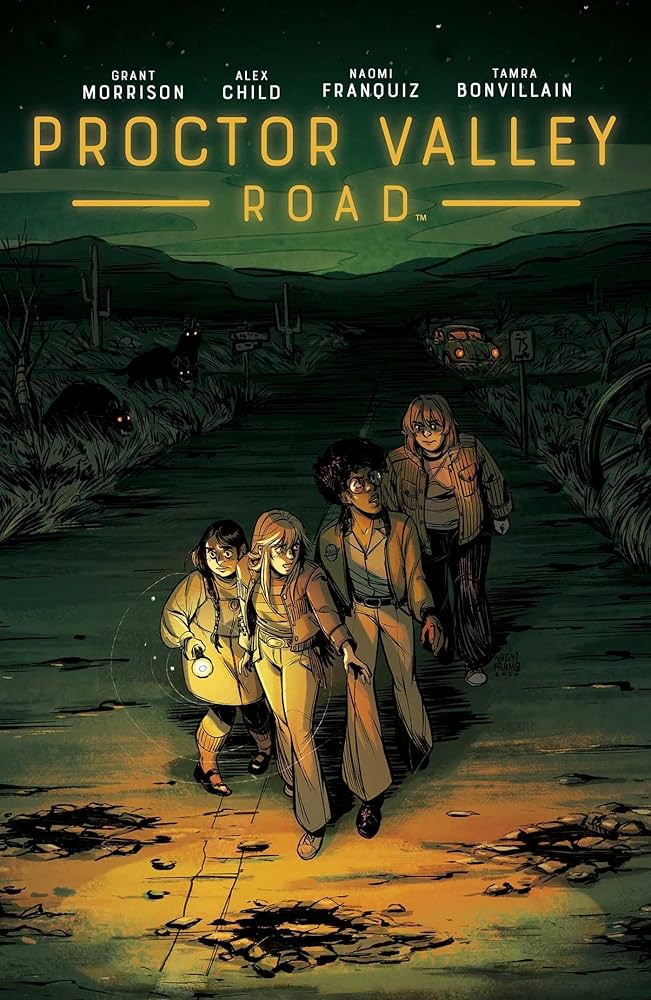
Proctor Valley Road (comic) — What to do when you just gotta have those Janis Joplin tickets? Well, charging for a trip down a supposedly haunted road seems like a good idea….just so long as it’s not actually haunted.
Writers Grant Morrison (Klaus), Alex Child (BBC’s Holby City) and artist Naomi Franquiz (Tales from Harrow County) have created this singular horror series released by BOOM! Studios. August, Rylee, Cora & Jennie organize a “Spook Tour” on the most haunted stretch of road in America, but when things go south, they not only have to face the monsters, but the town that holds them responsible.
What drew me in wasn’t just the creepy horror atmosphere, but the characters themselves. They all have a deep backstory, such as Cora’s crippling fear of the dark or Jennie’s dream of being an astronaut and taking down the social barriers in her way. You get to know these four well and care about them a lot more when things go south. The art is also really good and Franquiz does a great job at creating a horrifying world that is always getting scarier.
Check out the comic at https://www.boom-studios.com/series/proctor-valley-road/.
White Fire (book) — I’ve long been a fan of the Pendergast book series by Douglas Preston and Lincoln Child, and recently picked up where I left off awhile ago. Here’s a quick look at the plot:
“In 1876, in a mining camp called Roaring Fork in the Colorado Rockies, eleven miners were killed by a rogue grizzly bear. Corrie Swanson has arranged to examine the miners' remains. When she makes a shocking discovery, town leaders try to stop her from exposing their community's dark and bloody past.”
As I write this, I’m just about done with the book and it’s been a real pleasure to read. I loved the setting and how it plays into the story. The twists, while not hard to guess this time, were fun to encounter and the different characters are deep and well thought-out. History is often a big part of these books and the look into the town’s past, both good and bad, was one of the more enjoyable aspects.
If you’re looking to give this a read, visit https://www.prestonchild.com/books/whitefire/.
Pale Strangers (music) — The self-titled EP by this kickass rock duo is showing a strong start to this new project, formed following a separation of their last band, Rival Bones.
This is the kind of rock I grew up with, and listening to “Pale Strangers,” I’m reminded of a lot of the bands I love, while at the same time, appreciating the fact that these guys are bringing their own elements to the music.
The quick and fierce intro leads to “Deep Waters,” amps up fast from the opening chords. “Witches of the Wasteland” is my personal favorite from the album a real wave of sound with a chorus that I can easily see myself singing along to.
The five-track EP brings a lot to the table, with strong, precise instrumentation blended with some powerhouse vocals. This is the kind of music that has you moving right off the bat, and that alone tells me that this is a band worth listening to.
Hear all the band’s music at https://open.spotify.com/artist/2jvUQiQnxK3uLpj67dwP8N?si=hciGv-HyQ76m1nJpZ8LRRQ.
Thursday, July 4, 2024
“Hard Style Juice” tells a murder mystery through a wrestling lens
Writer Clay McCormack, artist Ricardo Lopez Ortiz and I dive into “Hard Style Juice,” a new series that you can only see on Comixology Originals. Here’s a look at the story for those new to it:
Wrestling is big business in arenas across the country, and for the Castros, it’s the family business. "King" Castro is the patriarch of the family, he’s also the manager, booker, promotor, MC, and owner of the local independent wrestling promotion KCPW, King Castro Pro Wrestling.
His daughter, Ramonita "Mona" Castro, has dreams of going to business school, but also has a penchant for wrestling. And his son, Rey Castro, is the star. A real showman, Rey is known as the "King of the Death Match," and he's on the verge of getting a contract to go pro.
Pro wrestling built the Castro family, and now it’s about to tear it apart. A shocking in-ring death sends the family spiraling out of control, and down the path of revenge as one big question rears its head: was it an accident? Or was it murder?
We talk about the series origins, and how Clay and Ricardo’s interest in wrestling played a role in shaping it. Clay talks about working with murder mysteries and how he paces the story, while Ricardo shares how he captured the feel of the wrestling world and his favorite parts to draw.
The series is now three issues in, with the fourth to be dropped on July 16, and we go into where the story is now and a few hints as to what we can expect in future issues.
Sunday, May 5, 2024
Citywide Bytes-Ryan Estrada shares some heartfelt stories in his new comics
Ryan Estrada joins me to dive into “The Silver City,” the second part in the “Student Ambassador” series, which features a new adventure with main character Joseph Bazan. We talk about Joseph and how he came to be as well as how he fares in the newest mystery. This comic is based on a very real place and Ryan goes into how he world-built the newest comic.
For “No Rules Tonight,” Ryan worked once again with his wife Kim Hyun Sook on this very real look at South Korea in the 1980s. We talk about what the country was like in this time period and how this influenced the story. Ryan shares the collaboration process with his wife and how this continues the story found in “Banned Book Club.”
Saturday, April 13, 2024
Mystery boxes and twist endings with “Jill and the Killers”
In the Oni Press four-part series, “Jill and the Killers,” teenager Jill Estrada is dealing with the unsolved disappearance of her mother, a police detective, and trying to get back to a normal life. . . . even as her friends become obsessed with Box Killers, a true-crime subscription game where each month’s “unsolved case” is custom-tailored to the life of its player. There’s only one catch: Jill’s game seems to be all too real—and when her clues begin to connect the dots to a very real series of disappearances in her hometown, Jill and her friends must conquer their fears and own personal struggles to solve the case.
Series writer Olivia Cuartero-Briggs joins us to talk about its origins, as well as why she chose to use a subscription box as the vehicle for the story. Olivia worked with artist Roberta Ingranata on “Jill and the Killers” and we talk about how the two met and the collaboration process. Olivia’s worked on murder mysteries before and goes into how the past experience informed this new project.
We’ve gotten the chance to read the final issue (out on April 17), and while we won’t be giving out any spoilers, Olivia does share how she devised the end of the series and hints at a possible continuation.
Tuesday, April 2, 2024
Lorenzo Petruzziello channels love of noir in his new book
Lorenzo Petruzziello took a veritable master’s course when writing his new book, “A Taste of Datura” (April 2, Magnusmade). In preparation, he studied the greats, not only the writers, but the filmmakers as well. “North by Northwest,” “The Third Man” and many more were the foundation of his book, but the story is all his own.
Nick seeks the value of an antique bracelet in his possession. He encounters Laura, an amateur medium cursed by uncontrollable visions. With Laura’s help, Nick closes in on the origin of his treasure. But as the word gets out, the quest puts them both in danger.
In this interview, Lorenzo talks about what inspired this book, how he made the main character of Nick Terenzi, and coming up with a story that was, in his words, “worth sharing.”
What about the genres of noir and suspense made you want to write a story in this style?
I am a fan of classic noir films because of the emotion and sensations they give the audience. Tension, darkness, suspense and mystery. But, what really draws me are the characters, and their immoral and seedy personalities. Their back stories, and the decisions they make that puts them in dangerous situations.
Some of my favorite films are “Strangers on the Train,” “North by NorthWest,” “The Third Man,” “The Big Sleep,” “Niagara” and “Double Indemnity.” Of course, many of these are Hitchcock classics – the master of suspense. I’m also a reader of the books that inspired the films, including stories by authors Patricia Highsmith and Cornell Woolrich.
I like the character of Nick Terenzi. How did you craft him?
Nick is meant to be a vague main character. Someone the reader can place anywhere in their imagination. I studied the main characters as portrayed by Cary Grant – specifically his character in “Arsenic and Old Lace.” And Joseph Cotton in “The Third Man” or “Double Indemnity.” These men had a small definition of who they were. Just enough to connect the audience and allow them to focus on the other characters and situations around them. I wanted Nick to be just as vague, and just as crafty.
This is your second crime novel, after “A Mistake Incomplete.” Was the writing process any easier for this book?
No and yes. It was difficult for me to come up with a story that was worth sharing. I knew I wanted to connect both books, but I didn’t know how. I wanted a connection, but not necessarily a sequel. I wanted the two books to be separate – not requiring the reader to have to read both – but have a connection or a nod to each. Add the uncertainty of the pandemic, my mind was just focused on stories. But, once I figured out a connection and premise, I knew what I was writing. Knowing that helped move the process along much faster than it did for “A Mistake Incomplete.”
Although my first book, “The Love Fool,” is not a crime story, it also has a slight connection to this world. There is no direct connection – just a subtle easter egg dropped in “A Mistake Incomplete.”
I read that Italy is a familiar place to you. How did the country inspire or shape your writing?
As a kid, I spent my summers in Italy with my grandparents. Each year, when school ended, I would be on a flight to Italy, and return just before school began in the fall. This started in middle school through college. After that, I travelled to Italy every year – spending less time than a whole summer, but there all the same. The time spent in Europe helped shape the man I am.
Speaking two languages and leaning in to the culture, I adopted a global mentality, that allows me the ability to connect with people from all walks of life. Allows me to see situations in many different ways. And allows me to focus on understanding views. So, Italy, and my time there, will always be an inspiration to anything I do in life.
Will there be more books? If so, what ideas are you working on?
When I started the journey of writing my first book, “The Love Fool,” I had moved to Rome temporarily. I thought to myself, ‘if I can write a book, then I will promise myself to write three.’ Once “The Love Fool” was completed and published, I knew my plan: to write stories set in cities that had meaning to me. Rome: because I was living there when I started this writing journey. Milan: Because I studied there in the mid-90s and really enjoyed being in that part of Italy. Naples: Because this is the region where I spent my summers. So, my personal Italian trilogy goal is now complete. Do I have more cities that I connect with? Yes. So there are ideas brewing. One is maybe return to Rome with crime. But, who knows what will be next? For now, I want to breathe and enjoy my accomplishment of completing my three novels I had promised myself.
Monday, December 18, 2023
Fantasy, children’s lit and more at the Rhode Island Author Expo
Kicking off this episode is Nishita Roy-Pope to talk about her new book, “Courage Kids: The Magic Soccer Ball.” It’s her debut book and we talk about how her background in business and as a diversity leader helped prepare her for this new role. Nishita talks about the different characters, how her kids helped with the ideas and what she hopes people take away from the story.
Up next, Ann Watt channels her 30 years as a critical care nurse into a memoir, “When Being a Nurse was Fun.” She shares a few stories from her time as a nurse and what inspired the book. We go into what nursing was like pre-COVID and how the pandemic changed everything.
Keith Carreiro is no stranger to the show, having been on before to talk about his nine-book series, “The Immortality Wars.” This blend of science fiction and fantasy centers on Pall Warren, a 16th-century warrior who wakes up to find himself in the far future. He’s now four books into the series with the release of “The Pilgrim” and we look at how the story has advanced.
Kelly Swan Taylor brings a little mystery to the show with her series “The Wright Detective,” now three books long. Tessa Wright is a seventh-grade student who solve mysteries with her friends. We talk about the main character’s creation, along with how her friends and father—also a detective—factor into the books. Kelly has a new book, “Frozen in Time,” and we talk about the intense plot that awaits.
Maggie Kozel brings things to a close with her book, “My Legs are Crying.” Like Ann, this book is centered on real-life experience in the medical world. Maggie’s book is based on her work with emotional-based illnesses, and we go into what they are and how her work impacted medicine.
Monday, October 30, 2023
Maggie Giles takes us on a “twisted” murder case
When cracked open, the case morphs into a full-fledged murder investigation with an unknown drug that seemingly connects a string of deaths. Quite a story, eh? Well, buckle up, because in this episode, Curtis and I talk shop with author Maggie Giles for her new book, “Twisted.” Along with being a great crime thriller, the story explores the different sides of crime and mental health and asks the question: How much are we responsible for when we aren’t fully in our right mind?
Maggie shares the origin of this story and all the different changes she made from first draft to finished product. This includes cutting down the narration from multiple points of view to just a few. She shares the lengthy research she had to do and how her time with Women’s Fiction Writers Association—including being in charge of social media—benefitted her during the story crafting process and in promoting her works.
Maggie takes us into the minds of her characters, which run the gamut of personality types. She talks about who made the final cut and which names got left behind (and may come back in a future book?).
Wednesday, September 20, 2023
William Sterling shows us why puppets are just terrifying
![]() |
| William Sterling |
In this interview, William takes us through the town of Hollow Hills, which is plagued by a series of brutal murders. We meet the toymaker, once a beloved member of the community, now the prime suspect in the killings. William talks about Sinclair Redman, a man with a dark and haunted past who must unearth the truth behind the killings as the bodies continue to pile up.
William talks about the concept of toys in horror and why it appealed to him for his new book. We look at his first time working with a publisher and his own strengths and weaknesses when it comes to promoting his work. Plus, there’s a great giveaway for those that pre-order the book!
Sunday, September 10, 2023
Death is just the beginning in Susannah Marren’s new book
In this interview, Curtis and I sit down with author Susannah Marren to talk about her newest book, “Maribelle's Shadow,” in which the death of Maribelle Walker’s adored and impressive husband Samuel unearths the secrets and lies between Maribelle and her sisters. Curtis and I talk about the theme of secrets, a common element in Susannah’s work and why it plays such a prominent role. We also look at how Samuel’s death leads to those secrets being revealed.
Susannah has a long career in teaching gender studies and guest teaching creative nonfiction. She talks about the research she did for the book, which included interviewing many women across the country, and what she learned. She also shares her favorite and most challenging parts to write.
Saturday, September 9, 2023
“Snakes of St. Augustin” brings a complex plot with a real-life inspiration
![]() |
| Ginger Pinholster |
By Max Bowen
In Ginger Pinholster’s new book, “Snakes of St. Augustine,” we’re introduced to a diverse array of characters who underwent all sorts of changes before the writer decided it was time to say “done.”In this book, available on Sept. 12 through Regal House, stolen snakes and a missing person set off a chain of events ranging from thrilling to romantic to deeply poignant. Based in part on the true, tragic story of Jason Harrison, a man living with bipolar schizophrenia who was killed by Dallas Police, “Snakes of St. Augustine” challenges assumptions surrounding mental illness and raises questions about the systems designed to keep communities safe.
In this interview, Ginger talks about the true story that led to this book, the many revisions it underwent, and how Florida played a strong role.
I’d like to begin with the real-life story that inspired this book. What was it and why did it connect with you?
When I saw a CNN news report of Dallas police shooting and killing Jason Harrison on June 14, 2014, the tragedy stuck in my head. Harrison’s mother had called the police because she needed help getting “Jay” to a hospital. Seconds after arriving on the scene, police shot the 39-year-old schizophrenic man five times, including twice in the back, according to CNN. Police bodycam video shows Harrison falling a few feet from his mother, who begins wailing, “Oh, they killed my son.”
Even now, this news report brings me to tears, especially because Harrison’s death was part of a broader trend: Of 994 people who were shot and killed by police officers in 2015, at least 25 percent suffered from acute mental illness at the time of their death, the Washington Post has reported. People with untreated mental illness are 16 times more likely to be shot and killed during an encounter with police, the Treatment Advocacy Center found.
How much of the story in your book is true?
In writing my novel, I did not attempt to recreate any specific event. In no way do the family members and police officers in my book resemble the real-life players in Jason Harrison’s tragic death. All of my characters are composites, representing two trends: Individuals with mental health conditions who die during police encounters, and burnt out police officers who face dangerous situations without the proper training or tools.
This novel is fictional, so it’s largely a product of my imagination. With that said, as a former teacher once told me, “It all comes from somewhere” – that is, deeply buried memories and life events tend to wind up in the stories that we write. In my case, losing my younger brother to mental illness, and subsequently finding a partner who has neurodiversity, clearly influenced me as I was writing “Snakes of St. Augustine.”
How does the theft of three snakes coincide with Gethin’s disappearance?
“Snakes of St. Augustine” follows a woman’s quest to save her troubled brother, Gethin, and her magical, maddening entanglement with an equally complicated man named Jazz. Gethin’s disappearance coincides with the theft of Trina Leigh Dean’s beloved snakes – including a rare Eastern indigo named Unicorn, Banana Splits the yellow ball python, and Bandit the banded king snake. While Gethin’s sister Serena searches for him, she gains an unlikely accomplice in Jazz, a homeless community college student. Meanwhile, Trina’s friend Fletch, a burnt-out cop, scours St. Augustine, Florida, for the stolen snakes … and for Trina’s drug-addicted sister Chelsea. Suspecting of stealing the snakes, Chelsea is also reportedly hiding out with Gethin. Fletch’s quest puts him on a dangerous collision course with Gethin, raising questions about community, family, and the power of compassion.
Tell me more about Serena.
Serena is a fitness trainer known on social media as “Serena the Savage.” She believes strongly in “the three P’s” – Perseverance, Patience, and Pluck – the values she inherited from her late father, who was in the military. After being abandoned by her mother, Serena takes charge of her younger brother Gethin. He is living with neurodiversity, but Serena is convinced there is nothing fundamentally wrong with him. Gethin only needs to stay off drugs and focus on a goal, in keeping with the three P’s philosophy, is what Serena thinks. His disappearance and ensuing events prompt Serena to reevaluate her perspective and what she knows about her brother.
Novelist Connie May Fowler (“A Million Fragile Bones”) commended the characters in “Snakes of St. Augustine.” She described the book as “a relentlessly beautiful and compelling story,” adding that “the novel will linger with readers long after the final page is read.”
Mickey Dubrow (“American Judas”) said “Snakes of St. Augustine” is “an engaging novel about desperate love and pilfered snakes,” and “Ginger Pinholster writes about neurodiversity with empathy and clarity. Her Florida reflects both the weirdness and beauty of her unforgettable characters.”
Why does she search for Gethin, as opposed to leaving it to the police?
Without providing any spoilers – Serena and Gethin’s girlfriend Rocky urgently want to find Gethin before the police find him. They want him to go to a hospital, and not to jail.
The story sounds like it’s got a lot of twists. Did this need to be planned out?
There are indeed many plot twists in “Snakes of St. Augustine.” I wanted readers to be surprised and eager to turn pages, yet satisfied with the ending, as if it was inevitable, in hindsight.
Writers often talk about being “Plotters” who carefully outline their stories, or “Pantsers” who fly by the seat of their pants. I consider myself to be a “North Star” writer. That is, I know the book’s North Star – the climactic scene and ultimate resolution – and I write toward that outcome.
This approach allows me to learn something new about my characters every time I sit down to write. Book development becomes a discovery process, and yet (read on), this approach can also be messy.
How much does the final version differ from the first draft?
Several characters in the original version of this book were killed off in the second or third draft. One of them changed genders. Names were changed, and most importantly, I changed character’s motivations to ensure that plot twists were always plausible.
Florida has been home to some interesting stories over the years. Does that factor into the book?
I didn’t use any “Florida Man” type stories, as I was writing my book, but the environment where I live became its own character. Many works of southern fiction have historically treated the physical setting, perhaps because of the transition from farmland to shopping malls, or from Florida jungle to high-rise condominium buildings, in many regions. As a writer, I feel a need to preserve cherished natural places, at least in the mind’s eye. I love to read immersive descriptions of physical settings, and to do that, I try to engage all five senses. Florida is a wild and beautiful place, and there’s no end to the state’s weirdness, such as monkeys colonizing a state park, or giant pythons invading the Everglades, or alligators inexplicably strolling through the ocean surf. Plenty of fodder for a fiction writer.
I live on a barrier island on Florida’s east coast, which is the largest loggerhead sea turtle nesting region in the world, and I’m hardcore into volunteer Turtle Patrol work. Several times per week, I search and document sea turtle nests. In between those experiences, I sit at my home computer, trying to immerse myself into a fictional world. If I become restless, I grab a notepad and ride my bicycle to a nearby park where there is a tower overlooking a thick marsh. If there’s a breeze and the mosquitoes aren’t too bad, I can hand-write a full scene from atop the lookout tower. Snowy egrets are plentiful. Occasionally, I’ll see a bright pink roseate spoonbill or a raccoon family, searching for food in shallow water. All of these Florida sights, sounds, and smells wind up in my fiction.
I’m currently working on Draft Number Two of Book Number Three. It’s a dual-timeline historical novel set in New Mexico (“Coyotes and Cradles” is the working title). It tells the story of a wounded warrior, Jemi, who is fighting to regain her confidence, in parallel with a nursing home resident, Rose, who is struggling to have her Native American heritage verified. The historical story delves into a shameful period of American history when, sadly, many Native American children were stolen from their families. I’ve also begun to outline a fourth novel. I can’t share details yet, but suffice it to say, there are sea turtles.
Thursday, August 17, 2023
Lyn Squire explores the death of Charles Dickens and the unfinished work in his new book
Charles Dickens' unexpected death shook the world in 1870, and since then, fans have tried to devise the ending to the iconic Victorian writer's last, unfinished mystery novel. Lyn Squire is one of those curious fans and in his book, “Immortalised to Death” (Level Best Books, Sep. 26), we see Dickens dead at his desk, slumped over his unfinished novel
In this interview, Lyn talks about what led him to take up the mystery, the clues he found along the way, and how Dickens’ last, unfinished novel, “The Mystery of Edwin Drood,” has become a quest for so many readers. Lyn also talks about the world of Dickens fans and some of his favorite works by the legendary writer.
What about Charles Dickens’ death led you to make it the plot of your book?
Charles John Huffam Dickens died on June 9th, 1870, leaving “The Mystery of Edwin Drood,” the novel he was then writing, only half finished. He penned the words that closed the sixth instalment (of a planned 12) on June 8th; the next day he was dead. The basics of the story as set out by Dickens are these: The sinister John Jasper, choirmaster at Cloisterham Cathedral, appears to be plotting to do away with Edwin, fiancé of Rosa Bud, so that he has a clear field to pursue his own mad obsession with the delightful young lady. Edwin disappears during a storm. Was he murdered by Jasper? And if so, how was Jasper brought to justice? Everyone who reads the completed first half of the Drood mystery inevitably tries to guess what happened in the story’s unwritten second half and, with luck, solve the mystery. Imagine my delight then when a clue that had not previously been explored by anyone, popped up before my astonished eyes. That clue led me to a fresh solution to Dickens’s story and that in turn became the plot for my novel, “Immortalised to Death.”
For those not familiar, tell me about Dickens’ death and why fans have tried to solve the last novel?
Interest in “The Mystery of Edwin Drood” has been immense and endures to this day. This must partly be because it is, after all, a story by the master, his last ever, and, moreover, the only mystery he ever wrote. But in my view, the main reason is that Dickens was writing a truly intriguing tale of a yet-to-be-committed murder when he died, leaving countless readers hanging.
The number of attempts made to discover the ‘true’ ending, ranging from the ingenious (a Sherlock Holmes pastiche) to the absurd (The Mysterious Mystery of Rude Dedwin), attests to the remarkable interest generated by the novel. A 600-page bibliography published in 1998, for example, lists almost 2,000 attempts to unearth clues in the text, decipher how the plot might evolve, and, of course, discover Edwin’s fate and, how Jasper, if he did indeed murder Edwin, is brought to justice. Interest in the story has continued into the 21st century, as evidenced by a Broadway musical in 2012 in which the audience chooses the ending, a PBS Masterpiece production also in 2012, and in 2014, a one-day academic conference in Senate House in London!
Absolutely. The clue that led to my solution has to do with the location of a diamond and ruby engagement ring. John Forster, Dickens’s literary agent and lifelong friend, claims in his 900-page biography of the author that the ring was to be found in Edwin’s breast pocket after he disappears. The distinctive jewels of the ring allow identification of Edwin’s decomposed body and lead to Jasper’s capture. This claim has been widely accepted, but there is good reason to question whether the ring was in Edwin’s breast pocket on the night of his disappearance. According to Dickens’s timeline, this would require that the young man carries a ring of considerable sentimental and monetary value around in his waistcoat pocket for several days. Would he be so casual with a priceless ring? Probably not. It is much more likely that he would lock it away for safekeeping. And if so, all the attempted continuations to the story based on Forster’s claim are wrong.
Could the possibility of the ring being somewhere other than on Edwin’s person have been totally missed by everyone else? To find out, I wrote up the evidence in support of my ‘clue’ as a short article and submitted it to The Dickensian (a UK publication devoted entirely to Dickens) where I knew it would be subject to rigorous scrutiny by Britain’s foremost Dickens scholars. Scrutiny complete, the editors accepted my article as an original contribution to the ongoing debate about the mystery’s ending, and published it in the Summer 2012 issue.
With that validation in hand, I examined the raft of new possibilities for the novel’s ending that had now been opened up. The one I finally fastened on is 100% consistent with what Dickens had written in the first half of the story, avoids the awkward period the ring had to remain in Edwin’s pocket, and reflects Dickens’s approach to storytelling and his literary tendencies as evidenced by his other novels. The full solution is set out in “Immortalised to Death.”
I’ll assume you’re a fan of Dickens’ work. What about it drew you in? Any favorites?
Dickens wrote over a dozen marvelously sprawling stories and introduced the world to some wonderful characters. That said, and this is obviously a matter of personal taste, I find many of his novels rather long-winded and too wordy. I like best his shorter books like “Oliver Twist,” “The Tale of Two Cities” (my number one choice) and “Hard Times.” I like stories with a strong plot, whereas Dickens built stories around his characters. Think of “The Pickwick Papers,” his first major literary success. The monthly instalments of this story recount a series of humorous incidents and embarrassing adventures linked, not by a continuous storyline laid out in advance, but by the foibles and eccentricities of the Pickwick Club members.
While this tendency to let the characters drive the story remained throughout his career, he did introduce more structure into his later novels and eventually adopted the practice of preparing notes outlining each story, the earliest surviving set being for “Dombey and Son” published in 1848. Interestingly, the notes for “The Mystery of Edwin Drood” stop at Instalment Six, the halfway point. The pages covering the second half of the novel have instalment numbers at the top but are otherwise totally blank. Dickens was obviously not going to provide a road map for anyone trying to work out the solution to his mystery.
What kind of research did you need to do?
Novelists writing historical fiction almost invariably draw on real people who live in real places and through real events. The more famous the subject of the story, the more likely that the reader will know something, and possibly a great deal, about that person. If too many historical inaccuracies creep in, readers will be jarred out of their enjoyment of the story and may stop reading.
In my case, the person in question was England’s most celebrated and beloved novelist – Charles Dickens. Ensuring historical accuracy, then, was a top priority for me. Here’s what I did. I first read several biographies of the author (including John Forster’s 900-page monster) and several other biographies of secondary characters. I also read all of his novels because I wanted to make sure that when Dunston wrote his continuation of “The Mystery of Edwin Drood,” he stayed true to the literary tendences of the great author himself. And I visited Gadshill Place, Dickens’s home in Kent, to make sure that the book’s description of the house was as faithful to the original as possible. I actually stood in his study where the murder in my novel is supposedly perpetrated. This may sound like a lot of work, but to my mind it was more of an opportunity to learn about a truly fascinating man who accomplished so much in his 58 years.
Tell me about Duston Burnett. Why does he take up the mystery?
Fictional detectives typically fall into two broad categories. One is the classic sleuth exemplified by the magnificent Sherlock Holmes with his extraordinary powers of observation and brilliant, never-wrong deductions. The other is the tough, hard-boiled private eye like Sam Spade who could be beaten to a pulp in one chapter and yet be back on his feet in the next ready to go. Of course, there are many variations on these stereotypes.
In my case, I wanted someone who was far from typical detective material. This thought led me to my protagonist, Dunston Burnett, a diffident, middle-aged, retired bookkeeper. For a quick mental (Dickensian) image of him, think of a latter-day Mr Pickwick. He does however have two talents. He has what his policeman friend calls “pre-ductions,” insights that jump well beyond the known facts and that, unlike Sherlock’s, may or may not prove prescient. And once he gets his teeth into something, he has the perseverance of King Bruce’s spider. The question confronting Dunston (and the reader) then, is this: Are his limited detective skills – pre-ductions and tenacity – anywhere near enough to unravel the apparently perfect murders he encounters?
This is the first of a series. What can we expect in future books?
This tension between Dunston Burnett’s limitations as a detective and the apparently unsolvable mysteries confronting him that lies at the heart of “Immortalised to Death” is carried forward into two other stories comprising The Dunston Burnett Trilogy.
How does Dunston fare? Suffice it to say here that the picture is mixed. In “Immortalised to Death” (to be published by Level Best Books on Sept. 26 of this year) Dunston’s envisioned conclusion to The Mystery of Edwin Drood takes him a long way towards solving a bigger mystery surrounding the death of Dickens himself, but perhaps not quite all the way. In book number two, “Fatally Inferior” (forthcoming in September 2024), he unearths the motive behind a woman’s disappearance but is that enough to lead him to the killer?
The third, “The Séance of Murder” (forthcoming in September 2025), is set against the spiritualist movement that swept through Victorian England. Here the issue is more dire: can Dunston expose the murderer of the heir to the Crenshaw Baronetcy before he himself is done away with? If any of these stories generate interest, I will look for a new character and start another series. If they turn out to be duds, I’ll take up golf.
You have a lengthy writing background. How did this help with the writing of this book?
The surprise was that I wrote a novel at all. Throughout my 25-year career as a development specialist, I wrote over 30 articles and several books within my area of expertise. Illustrative titles are: “International Development: Is It Possible?” (joint with Nobel Laureate J.E. Stiglitz, Foreign Policy), and “Fighting Poverty” (American Economic Review). I was also lead author for “World Development Report, 1990,” which introduced the metric – a dollar a day – still used today to measure poverty worldwide. Nothing here to suggest I would ever write a novel.
And then I read “The Mystery of Edwin Drood.” I had always been an avid reader of whodunits, but it was the thrill of solving Charles Dickens’s unfinished story that convinced me to put aside my development pen and turn to fiction.
I saw that you write book reviews. What does a book need to get the thumbs-up from you?
I have reviewed over 100 mysteries for City Book Review (Sacramento). The ones that stand out have something unique about them. Given the enormous number of mysteries that come off the press every year, the greatest challenge must surely be finding that unique something. This could be the writing style (not often), or the lead character (more often), but usually for mysteries it is the plot. Examples that spring to mind are “The Pale Blue Eye” by Louis Bayard, an inspired story of revenge at West Point, with its truly inventive twist in the tale. Or more recently, “The Eighth Detective” by Alex Pavesi, which makes the reader think more generally about mysteries and their structure. These stories earn five stars in my estimation because they had the magic of uniqueness about them. My hope is that the original solution to “The Mystery of Edwin Drood” presented in “Immortalised to Death” will nudge my novel towards the fringes of the unique category.